All ArticlesGeneral Contracting
Footing Excavation and Frost Depth: What Happens Before the Concrete
Cranberry Contracting NOV 27, 2026
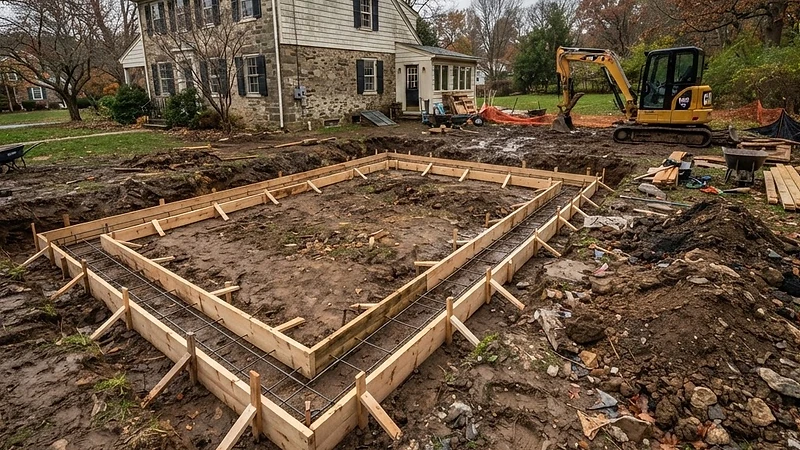
What a footing dig actually involves around Cranberry Township: frost depth, what the inspection checks, the soil conditions that change the price, and the mistakes that cause settlement cracks.
Every visible decision in an addition, garage, or deck rests on a hole in the ground that gets filled with concrete and never seen again. The dig sets the elevation, the depth, and the condition of the soil the structure will actually bear on. Get it wrong and the symptoms show up years later as a crack through a wall or a door that stops closing in February.
Footings have to bear on undisturbed soil below the frost line. Around Cranberry Township that depth is generally taken as 30 to 36 inches below finished grade, and the exact figure comes from your code official rather than from a general rule.
The footing inspection happens with the trench open, before any concrete goes in. An inspector is looking at four things: that the trench reaches the required depth, that the bottom is undisturbed and level, that the forms or tubes are set where the drawings show them, and that reinforcement is in place and properly supported.
Once the pour happens, none of that can be verified again without demolition. That is why the dig and the inspection have to land on the same day, and why a schedule that treats them as separate events loses a week.
Western Pennsylvania yards are rarely uniform. The conditions that show up most often on our digs:
Utility locates first, always. Then the dig, spoil staged where it can be reused for backfill rather than hauled away, then the inspection, then the pour, then curing before anything is framed on top. Removing the forms and backfilling come after the concrete has gained strength, and backfill goes in compacted lifts so the ground beside the foundation does not settle into a trench a year later.
When an addition ties into an existing house, the dig also has to avoid undermining the original footing. That is a hand-dig or a shored dig, not a machine scoop, and it is the step that most often gets rushed on a cheap job.
Send the drawings if you have them, or the rough size of the addition or outbuilding, and we will walk the lot and quote the excavation and foundation together. See what light excavation and site prep covers, and how we pour the footers and foundation walls that follow. Call 724-242-8020, Monday through Friday, 7 a.m. to 5 p.m.
Talk to the Cranberry build team. Free on-site consultation, transparent pricing, and craftsmanship that lasts.
Request a ConsultationTake the next step from reading to scoping: the services behind this guide, the finished work, and the answers homeowners ask before signing.
Every scope we build, from kitchen and bath remodels to basement finishing.
Completed builds across Butler County and the northern Pittsburgh suburbs.
Licensing, permits, payment milestones, and fixed-price contracts.
Book an on-site walkthrough and get a fixed-price estimate.
We use cookies to see how the site is used so we can improve it. You choose whether to allow them. The site works either way.